
E-Chulo
E-CHULO: ELECTRIC COOKING FOR LIVELIHOOD OPPORTUNITIES
Across Nepal, thousands of small businesses still rely on firewood and LPG for daily cooking despite having access to electricity. Cooking fuel costs continue to rise, while traditional cooking systems create heat, smoke, operational inefficiencies, and unstable expenses for small enterprises.
At the same time, electricity in many areas is still underutilized for productive economic activities. Electricity is used mainly for lighting and household appliances rather than income-generating work in rural and peri-urban areas.
Small businesses need affordable and reliable cooking systems, while Nepal’s energy transition requires greater productive electricity use. The project connects these two challenges through a practical and market-oriented approach.
WHAT THE PROJECT DOES??
The project supports micro businesses such as tea shops, canteens, and small restaurants to transition from firewood and LPG to electric cooking technologies.
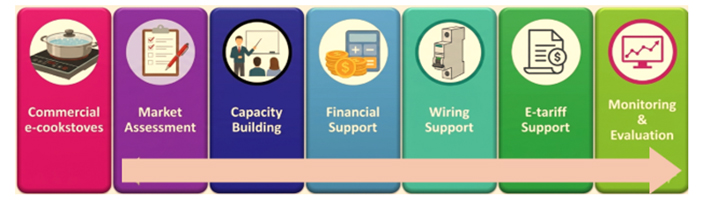
The approach goes beyond appliance distribution. It combines technology, training, local technical support, financing pathways, and demonstration-based learning to create a sustainable ecosystem for electric cooking adoption.
The project focuses on:
- Reducing cooking fuel costs for businesses
- Improving operational efficiency and productivity
- Increasing productive electricity demand
- Reducing dependence on biomass and fossil fuels
- Supporting local technical and supply ecosystems
- Building a replicable model for other stakeholders
Project Methodology
|
Project Title |
E-CHULO: Electric Cooking for Livelihood Opportunities |
|
Project Type |
Productive Use of Electricity and Economic Development |
|
Implementation Area |
All areas of Nepal (Rural and peri-urban) |
|
Target Groups |
Tea shops, canteens, small restaurants, micro food enterprises |
|
Main Objective |
To reduce dependence on firewood and LPG by promoting electric cooking as a productive business solution |
|
Key Activities |
Business assessment, electric cooking demonstrations, appliance deployment, training, financing support, technical service development, monitoring and documentation |
|
Project Components |
Technology support, capacity building, financing pathways, repair ecosystem, productive electricity use promotion |
|
Expected Outcomes |
Lower fuel costs, increased business efficiency, productive electricity demand growth, reduced biomass use, improved working conditions |
|
Environmental Contribution |
Reduced firewood and fossil fuel use, lower emissions, cleaner commercial cooking systems |
|
Economic Contribution |
Reduced operational costs and stronger income stability for micro enterprises |
|
Social Contribution |
Cleaner kitchens, improved safety, better working conditions and local skill development |
|
National Alignment |
Supports Nepal’s NDC targets, SDGs and Carbon Neutrality Vision 2045 |
|
Project Approach |
Subsidy based adoption model |
|
Long-Term Vision |
A scalable national model for productive use of electricity |
Be a part of this project